Origin & lineage
A tradition shaped by efficiency.
Wing Chun is a close-quarter system of simultaneous defence and attack, using positioning and strategy to answer size and strength.
About Wing Chun
Wing Chun techniques counter and strike simultaneously, helping the practitioner stay ahead. The system uses punches, kicks, elbows, knees and pressure-point strikes at close range, while manipulating body mechanics to disrupt an opponent’s balance.
Its reliance on deflection, positioning and strategy makes it practical in situations involving a larger or stronger adversary. Training can develop self-defence, fitness, stress relief, confidence, awareness, speed and power.
History of Wing Chun
The traditional account places Wing Chun’s beginnings during the Qing dynasty, when martial arts practice and weapon ownership were restricted. The Shaolin temple became associated with secret training, but the lengthy path to mastery was ill-suited to preparing people quickly.
According to the tradition, five grandmasters gathered to create a more efficient system from the strongest elements of existing styles. Ng Mui, a nun and one of those masters, survived the destruction of the temple and passed her knowledge to a young woman named Wing Chun—“hope for the future.” The art took her name and was passed on through carefully selected students.
Wing Chun lineage
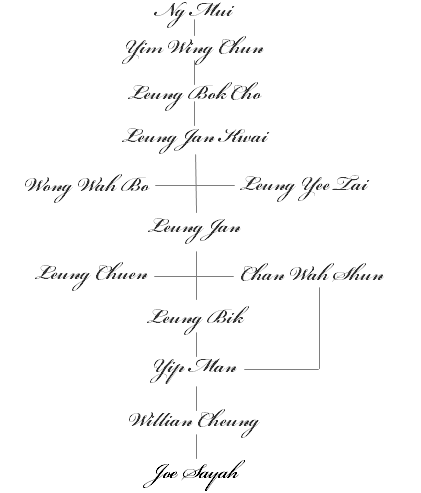
Yip Man began teaching Wing Chun publicly in Hong Kong in 1950. His students included William Cheung; both Yip Man and Cheung trained Bruce Lee, whose foundational art was Wing Chun.
Master Joe Sayah began training directly under Grandmaster William Cheung at age nine and was certified at Master level under him in 2001. He has since taught thousands of students, including many who went on to become instructors.
Experience the system.
History makes sense when you feel the principles in motion.